Photo by Vincent Brillant
TIME: 11:00 AM - 12:30 PM
Description
What does it mean to design a place of homage that is simultaneously an act of urban repair, infrastructure mediation and ecological intervention?
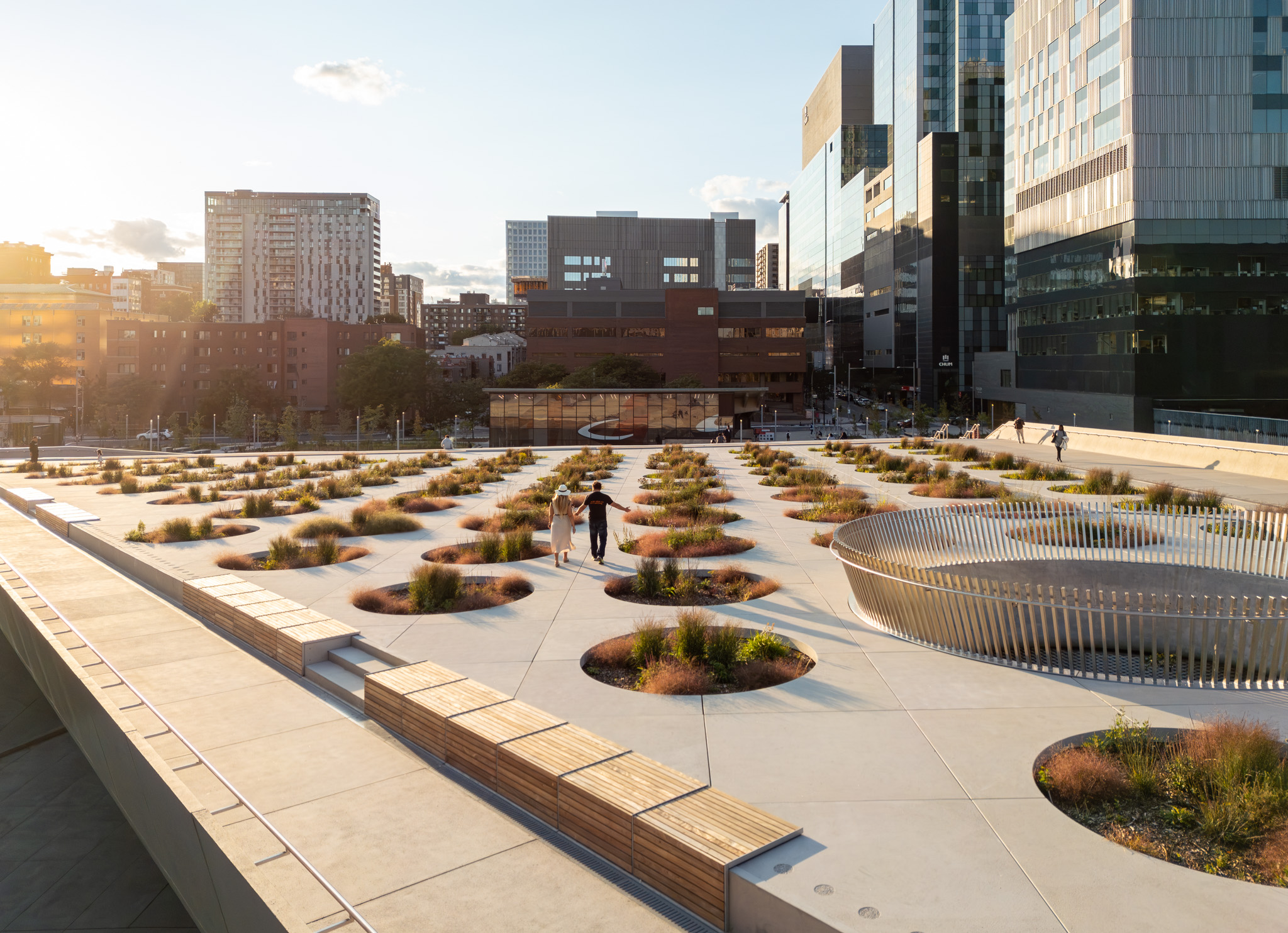
This session examines Place des Montréalaises, a signature civic project designed by Lemay in collaboration with artist Angela Silver and the engineering team at AtkinsRéalis. Located in the heart of Montreal the new plaza creates a multifunctional public esplanade connecting Old Montreal and downtown, where for decades a sunken expressway fractured the city. Conceived as a reparative gesture, both spatially and symbolically, the project inscribes the memory and legacy of 21 women into the urban fabric.
More than a commemorative plaza, the project operates as layered urban infrastructure: a suspended meadow above active transit, a civic stage for cultural programming, and a resilient ecological system planted above tunnels and constrained soil volumes. The commemorative elements are designed not as static markers, but as spatial devices that allow memory to be encountered, interpreted, and recomposed over time. The design also engages in dialogue with Marcelle Ferron’s stained-glass installation at Champ-de-Mars metro station and reframes Place Marie-Josèphe-Angélique within a broader narrative of memory and justice.
Through a co-presentation by a representative of the City of Montreal and two key members of the design team, the session will unpack how intention was embedded into every layer of the project, from planting strategy and material expression to spatial sequencing and urban integration.
Presenters will address:
- How cities can repair symbolic and physical fractures
- How commemoration can be embedded not only in artistic installations but in living systems that address climate change and support biodiversity
- How landscape architecture mediates infrastructure
- How governance and competition structures enable integrated practice
Participants will gain insight into how civic projects can confront the historic under-representation of women in the public domain through spatial systems that make memory inhabitable, evolving, and collectively experienced. Using this case study, the session will illustrate how remembrance can structure design decisions at every scale, while navigating governance complexity, infrastructure constraints, and transdisciplinary collaboration.
Learning Objectives
- Consider How Civic Intent Can Inform Design Decisions
Examine how political mandate, public participation, and commemorative objectives can shape both architectural and landscape responses—from structural systems and circulation to ecological performance and programming.
- Share Strategies for Urban Repair in Complex Contexts
Discuss collaborative approaches to transforming infrastructural scars into resilient civic ground while working above active transit systems.
- Explore Commemoration as an Integrated Spatial Framework
Reflect on how architecture and landscape architecture can work together to move beyond static monumentality and develop evolving forms of homage embedded in topography, planting systems, material expression, and spatial sequencing.
- Reflect on Transdisciplinary Practice in Public Work
Consider how architects, landscape architects, engineers, artists, and municipal stakeholders can develop a shared design language that supports reparation, representation, and long-term public life.
Presenters:
Claudia Villeneuve, Landscape Architect, AAPQ, CSLA - President, Association des architectes paysagistes du Québec and Team Lead, Public Squares, Ville de Montreal
For over 25 years, Claudia Villeneuve has been involved in the management, planning, design, and realization of large-scale, multidisciplinary landscape projects. A certified member and current President of the Association des architectes paysagistes du Québec (AAPQ), she brings extensive experience in both private and public sector practice.
After earning her bachelor’s degree from Université de Montréal in 1997—where she received the Canadian Society of Landscape Architects Medal of Excellence—Claudia worked for approximately 15 years as project manager and later project director with Daniel Arbour & Associés (subsequently Groupe IBI-DAA). During this period, she contributed to major urban development, civic, institutional, commercial, and infrastructure projects in the Montreal region, as well as international initiatives in Morocco and Haiti, including the rehabilitation study of the Champ de Mars public squares in Port-au-Prince.
In 2013, she joined the Ville de Montréal within the Service des grands parcs, du Mont-Royal et des sports. In 2020, she became team leader responsible for the development of public squares, overseeing the management and coordination of Place des Montréalaises, a flagship civic project for Montreal.
Patricia Lussier, AAPQ, CSLA, OALA – Landscape Architect, Partner, Design Principal, Lemay
For more than 25 years at Lemay, Patricia Lussier has approached landscape architecture as a narrative discipline—one that reveals identity, memory, and collective meaning through space. Her work bridges architectural and landscape sensibilities, allowing her to develop projects distinguished by both formal clarity and conceptual depth.
Patricia’s practice foregrounds commemoration, cultural interpretation, and the expressive use of material and vegetation. She conceives each project as a unique response to place, integrating activation strategies, ecological performance, water management, and strong relationships with the built environment.
Her experience across numerous multidisciplinary competitions and international contexts has shaped a design approach grounded in collaboration and precision. At Place des Montréalaises, Patricia led landscape design strategies, embedding commemorative and homage in a multilayered approach going from planting systems to spatial choreography, and material articulation.
Jeffrey Ma, M.Arch – Senior Design Director, Lemay
For over 15 years, Jeffrey Ma has cultivated a human-centred design practice where inclusivity and research inform architectural innovation. His work explores the intersection of spatial experience, wellbeing, and social equity—addressing the physical, cultural, ecological, and psychological dimensions of the built environment.
Jeffrey’s transdisciplinary methodology bridges architecture, landscape, and urban systems, enabling responsive solutions to complex civic and institutional challenges. His portfolio includes major public projects such as Place des Montréalaises, the REM transport network, and the Centre hospitalier de l’Université de Montréal.
At Place des Montréalaises, Jeffrey contributed to the integration of architecture, landscape, and infrastructure systems, helping develop a coherent spatial language that supports commemoration, regeneration, and civic belonging.
Pricing:
Licensed OAA Members: $0 + HST [FREE for OAA Members!]
OAA Interns and Students: $0 + HST [FREE for OAA Members!]
Non-Members: $63.00 + HST
NOTE:
1. An automatically generated confirmation will be emailed to you (once your registration goes through)
2. Please mark the time and date in your calendar
3. The OAA will email the Zoom Access Link to you one-day prior
4. OAA webinars are delivered via Zoom: Please check this Zoom Test Link or speak with your IT Consultant ahead of time, to ensure your device is compatible with Zoom. For technical concerns, please see the Zoom links for Technical Requirements and also their Download Centre.
For more information on the OAA Webinar Series click here.
If you have any questions or concerns, contact
OAA Continuing Education
e: OAAContinuingEducation@oaa.on.ca
t: 416.449.6898 Ext: 232
Attendance Policy: Members are required to attend at least 80% of a webinar in order to qualify for Continuing Education learning hours.
Cancellation Policy: Cancellations must be made at least 48 hours prior to the webinar in order to receive a refund. Webinar fees are not refunded if the cancellation is received after the deadline or if you are unable to attend